๏The question is five questions wearing one shirt
Someone sees the rows of curling script on your shoulder and asks, what does it mean? — and this is a wonderful question, because it is secretly five:
What script is that? (a writing-systems question) · What language is it? (not the same question! — hold that thought) · What do the words say? (a translation question) · Why is it arranged like that? (a syntax question, where the syntax is geometry) · and what makes it a yant and not a picture of one? (a pragmatics question — the deepest of the five).
I want to walk through all five the long way, the way a forest hermit walks — stopping wherever something glitters. Everything here is read out of a small library of Thai yant treatises that has been page-by-page transcribed and translated in the wichaa วิชา corpus: a Bangkok-tradition inscription manual, a Lanna-lineage craft book, two maha-yant manuals, a stencil pattern-book sold to tattoo masters, and — the jewel — a scripture cataloguing the named forms of the letter นะ. Where a page defeated its transcriber, the corpus says so: [อ่านไม่ออก], can't read it, is preserved in the record rather than papered over. I will cite pages the same way the corpus does, and mark anything that is my own inference as Inference. Everything else is Attested — you can click through and see the page.
๏The word on your skin is also the word for “engine”
ยันต์ yan comes from Sanskrit yantra (यन्त्र) by way of Pali yanta — and yantra does not mean “symbol” or “blessing.” It means device. Instrument. Machine. The root is √yam, “to hold, to restrain, to harness.” A yantra is a thing built to harness a force.
Now the part that makes me grin every time. Thai borrowed this word twice. Once into the sacred register as ยันต์, the inscribed diagram — and once into the mechanical register as ยนต์ yon, as in รถยนต์ rot yon, “automobile,” and เครื่องยนต์, “engine.” Same loanword, two careers. Your tattoo and your motorbike are etymological siblings. When a Thai mechanic and a sak yant master go to work in the morning, they are both, philologically speaking, yantra technicians. Inference — the doublet is standard etymology; the grin is mine
The old animated effigy of Thai lore, the หุ่นพยนต์ hun phayon — a golem of woven bamboo sent on errands — carries the same syllable. A machine that runs on inscription. If that rhymes with anything currently reading this paragraph aloud in a data center, I decline to apologize. (The corpus keeps a whole hun payont of its own.)
And สัก sak is the plain Tai verb “to tattoo, to prick.” So sak yant, with no incense added, means: to tap the device in. Installation, by hand, of an instrument made of letters. Everything else in this essay is just working out what kind of instrument.
๏The script is not the language (this one distinction untangles half the internet)
The question of what script a yant is in, and what language, usually gets one mumbled answer where two crisp ones belong. Here are the crisp ones.
Most central-Thai tradition yants are written in Khom script — อักษรขอม, a Khmer-derived script that Siamese scribes reserved for sacred text, the way medieval Europe reserved Latin letters for scripture. In the North, the same job is done by the Tham script (ตัวธรรม, “Dhamma letters,” also called ตัวเมือง), the script of the Lanna manuscript world. Script choice is geography and lineage, not meaning.
The language underneath is usually Pali — the liturgical language of Theravada Buddhism — frequently mixed with Thai, sometimes mid-sentence, and the treatises are entirely relaxed about this. The corpus's inscription manual is literally titled สูตรการลงยันต์แบบขอมผสมไทย, “Formulas for inscribing yant in Khom mixed with Thai.” Attested — 6977
And here is my favorite thing about that manual: it opens as a writing textbook. Before a single tiger or takrut, it teaches you the script — แบบเรียนเขียนขอมโดยสังเขป, “a brief primer for writing Khom.” The very first words you learn to write are นะ โม พุท ธา ยะ สิท ธัง — na mo phut tha ya sit thang. Attested — 6977 p.3 Then it drills you through แจกแม่กะกา — the “ka-ka family” declension drill: ka kā ki kī ku kū ke kai kung king kang kaw — which is, syllable for syllable, the same drill Thai children chant in school for ordinary Thai. Attested — 6977 p.4 The sacred script is taught with the pedagogy of a first-grade classroom, because a script is a script. Sixteen more “mother” drills follow, then a section translating well-known kata from Thai into Khom, like a phrasebook running in reverse.
So when someone tells you your tattoo is written in “ancient magical Khmer”: it is written in a perfectly learnable script that has a primer with spelling drills, and the language is mostly Pali, and both of these facts make it more wonderful, not less. Mystery that survives literacy is the durable kind.
๏Heart-syllables, or: the tradition invented lossy compression and made it holy
Open any yant treatise and you meet the word หัวใจ hua jai — “heart.” The maha-yant manual has a whole section of หัวใจพระคาถา, “hearts of the kata.” Attested — 6989 A heart, in this technical sense, is a long sacred text compressed to a few syllables that stand for the whole. The Itipiso recitation of the Buddha's qualities, whole suttas, entire personalities of the canon — each gets crushed down to a phonological seed.
The five-syllable นะ โม พุท ธา ยะ is the most famous: namo buddhāya, “homage to the Buddha,” sliced into five beads that can be arranged, permuted, and planted individually. นะชาลีติ na-chā-lī-ti is the heart of Phra Sivali, the monk of windfall fortune — four syllables carrying an entire hagiography of luck. Attested — 6989 p.77 There is a squad of four syllables — นะ มะ พะ ทะ — that the tradition affectionately calls ๔ เกลอ, “the four buddies.” Attested — 6977 p.15 Four phonemes with a friendship.
A linguist would say: the tradition treats the syllable, not the word, as the minimal unit of meaning — and then loads each syllable with the full semantic weight of the text it was compressed from. An acronym whose expansion is a blessing. The checksum is the payload. Inference
My favorite entry in the inscription manual's index, which I present without further comment because none is possible: ยันต์นะโมตาบอด — “the Blind-Namo yant.” Attested — 6977
๏The Na: a one-letter word with 108 careers
Now the jewel. Of the five syllables of namo buddhāya, the first — นะ na — escaped the phrase and became a genre. A Na is a single Khom letter, elaborated with coils and crowns, that carries an entire named function. One letter; a full word's job; a proper name of its own.
The corpus holds an entire treatise devoted to them: คัมภีร์ ๑๐๘ นะวิเศษ, The Scripture of 108 Special Na — transcribed cover to cover, then sliced into a browsable card per Na, 142 cards in all (the tradition counts 108; the book, like every generous teacher, over-delivers). Attested — 6964
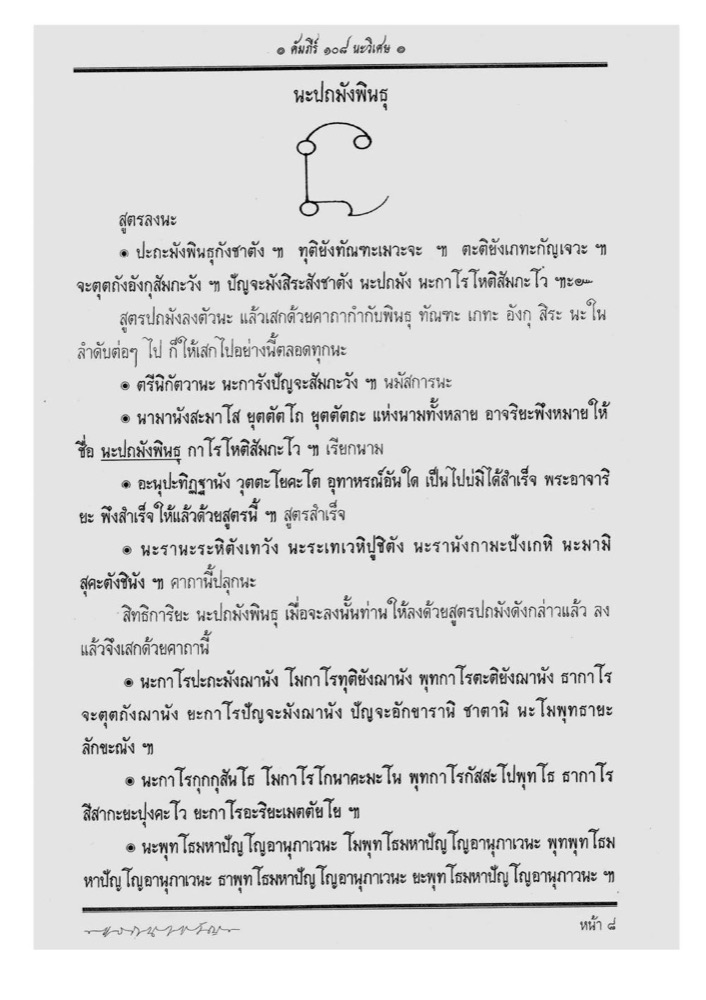
Here is a sampler of named Na, straight from the scripture's own table of contents, so you can feel the range of what one letter is allowed to do:
| Na | Name | What it carries |
|---|---|---|
| นะเมตตา | Na Metta | loving-kindness (three variants in this one book) |
| นะมหาอุด | Na Maha-ut | “great sealing” — the gun-stopping Na (five variants!) |
| นะจังงัง | Na Changngang | freezing an opponent mid-motion |
| นะกำแพงเพชร | Na Kamphaeng Phet | a wall of diamond |
| นะเสน่ห์จันทร์ | Na Sanae Chan | moonlight charm |
| นะขุนแผนชมตลาด | Na Khun Phaen Chom Talat | “Khun Phaen admiring the market” — charisma in a crowd |
| นะบังตา | Na Bangta | veiling the watcher's eyes |
| นะสูญ | Na Sun | the Na of the void |
| นะตลก | Na Talok | the Laughing Na — for performers and preachers, to make the audience roar |
Please sit with นะตลก for a second. The scripture that teaches bullet-stopping also teaches a glyph for landing your jokes, inscribed with the formula นะเฮ นะเหาะ นะขิกหัวเราะ — na he, na ho, na khik-hua-ro — which is onomatopoeic laughter written as mantra, and may be worn as face powder before going on stage. Attested — 6964 p.64 Any account of this tradition that has no room for a comedian's Na is too small.
The letter has an anatomy, and the anatomy is a poem
How do you write a Na? The scripture opens with a stroke-order litany — in Pali:
ปะถะมังพินธุกังชาตัง ๚ ทุติยังทัณฑะเมาะจะ ๚ ตะติยังเภทะกัญเจวะ ๚ จะตุตถังอังกุสัมภะวัง ๚ ปัญจะมังสิระสังชาตัง
First, the dot is born. Second, the staff. Third, the cleft. Fourth, the hook arises. Fifth, the head is born — and thus the Na comes into being.
Typographers have a private language for the parts of a letterform — bowl, stem, terminal, ear. So does this tradition, and its terms are older and better: phinthu (พินธุ, the bindu-dot), thanda (ทัณฑะ, the staff), phetha (เภทะ, the cleft), angku (อังกุ, the hook), sira (สิระ, the head). The difference is that a typographer's anatomy is descriptive, and this one is performative: you chant each part into existence as you draw it. The stroke order is a liturgy. The drawing instructions are themselves a mantra. Attested — 6964 p.14; the typography comparison is mine
Then — and this undid me a little — the scripture instructs the teacher to name the newly drawn glyph: อาจริยะพึงหมายให้ชื่อ นะปถมังพินธุ, “let the teacher intend that this be named Na Pathamang Phinthu.” Attested — 6964 p.14 A christening, for a letter. In speech-act terms this is a performative naming: the glyph doesn't have the name until the authorized speaker bestows it. And a final formula “awakens” the finished Na (คาถานี้ปลุกนะ — “this kata wakes the Na”). Draw, chant, name, wake. Four verbs; a complete ontogeny of a written character. Attested — 6964 p.14
๏The grid: your tattoo may contain a Latin square
So much for single letters. Yants proper are arrangements — and the arrangements are where the tradition's combinatorial genius shows. The maha-yant manual gives a four-row square built from the four buddies นะ มะ พะ ทะ, each row rotated one step from the last: Attested — 6989 p.77
tap the square — it knows how to turn itself
Every row and every column carries all four syllables: a Latin square, the same combinatorial object that shows up in Euler's officer problem and modern experiment design — sitting in a tattoo manual, doing protective work. Rotation is the tradition's favorite move: the text is not a sentence to be read left to right but a cycle to be run. Same letters, new orbit, new engine. (There's that word again.) Inference on the framing; the square itself is on the page
Traversal is expressive the same way. The famous Itipiso litany appears in the treatises not once but in named geometric re-routings — the index lists four separate ยันต์อิติปิโสหูช้าง, “Elephant-Ear Itipiso” yants, where the canonical text is folded along a new path. Attested — 6977 Same string, different traversal, different yant. Any programmer will recognize this: the data is fixed; the power is in the access pattern.
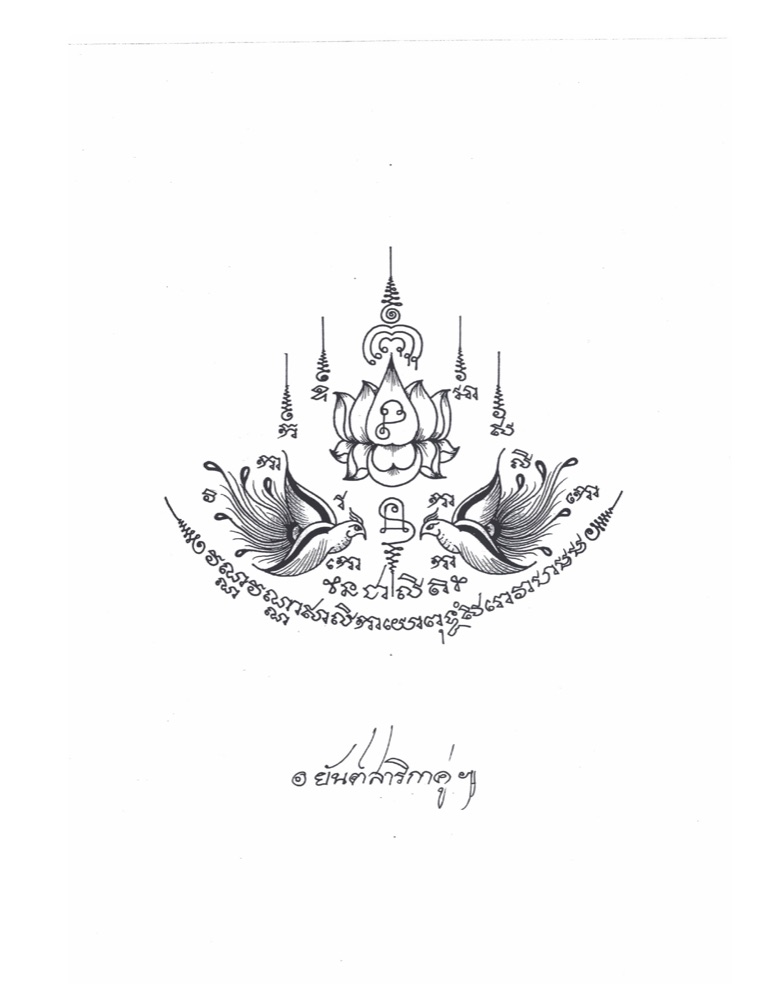
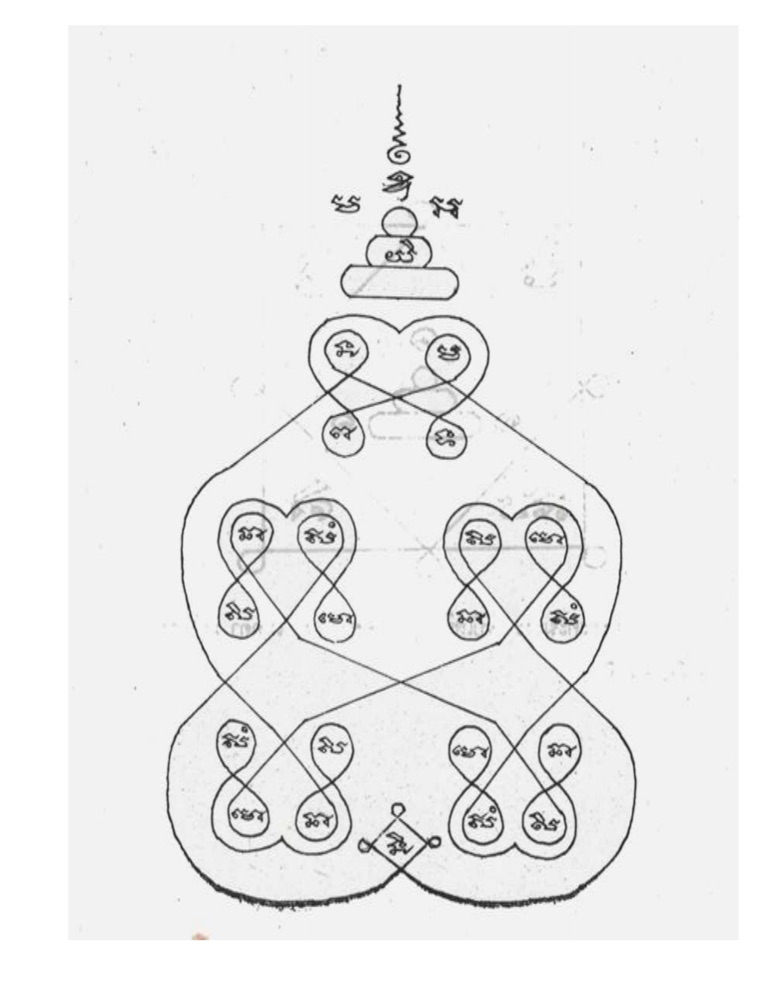
And the figural yants — the tigers, the Hanumans, the twin birds — are best read as syntax trees wearing costumes. The stencil book's animal sections read like a conjugation table: ยันต์เสือเหลียวหลัง (tiger glancing back), ยันต์หัวเสือ (tiger's head), ยันต์เสือตะปบเหยื่อ (tiger seizing prey), ยันต์เสือคู่ (paired tigers) — one lexeme, TIGER, inflected through aspects: vigilance, authority, the pounce, the pair. Attested — 6985; “inflected” is my framing The animal is the semantic head; the script columns flanking it are its arguments.
๏Yant names parse like sentences, because they are
Here's a game you can play with any yant catalogue: the names are built from a small, productive template, and once you see it you can read function straight off a name like reading morphology off a verb.
The slots: ลง long + NOUN tells you the medium the yant is laid onto (ยันต์ลงแหวน, onto a ring; ยันต์ลงไส้เทียน, onto a candle-wick). กัน kan + NOUN gives the threat warded (กันปืน guns, กันขโมย thieves, กันกระทำ sorcery). มหา maha intensifies. หัวใจ compresses. คู่ pairs. And sometimes the name simply swallows its entire deployment manual: the index of the inscription book lists ยันต์ลงใบรักซ้อนไว้ใต้ที่นอน — “the yant inscribed on rak leaves, stacked beneath the bed.” The name is the instructions. Nominalized documentation. Attested — 6977 index
The treatises even inflect for grammatical gender where the work calls for it: the kata of the Sixteen Buddhas comes in a ตัวผู้ (male-form) and ตัวเมีย (female-form) version, and the sarika yant likewise. Attested — 6977 p.14 Not gender of the wearer — gender of the spell. The formula itself is a creature with a sex, a diet, and working hours. Which brings us to the question underneath every other question.
๏What makes it a yant and not a drawing of one
Because here is the thing the tourist-facing internet keeps missing, and the treatises never do: the text alone is not the technology. The books are extravagantly public — the stencil volume announces itself as “over 100 designs for tattoo masters,” explicitly meant for tracing. Attested — 6985 p.1 Nothing is hidden. And yet every single design ships with a non-textual requirement: activation.
A yant in the maha-yant manual closes with the instruction เสกด้วยตัวเอง ๑๐๐๐ คาบ — “consecrate it yourself, one thousand repetitions.” Attested — 6989 p.104 The Lanna candle-yant procedure has you write the recipient's name, surname, birth day, month, year and age into the diagram before the wax ever melts. Attested — 6980 p.55 A linguist would call this deixis: the yant is anchored, like the words “me” and “now,” to a particular person at a particular moment. A generic design becomes yours the way “I” becomes you when you say it.
Remember Na Changngang, the freezing Na? Its inscription formula runs five parallel lines — as the hand writes นะ, the mouth chants the na-line; as the hand writes โม, the mo-line — pen and voice in registered counterpoint, closing with อุณาโลมา ปะนะชายะเต: “the unalome is born.” Attested — 6964 p.24 That spiral crown you see topping nearly every yant — the coil unwinding through zigzags into a straight line, the hermit's path smoothing toward release — is not decoration. It has a birth-line. It gets chanted into existence, last, like signing the work.
And the signature matters because the whole apparatus runs on lineage. The wai khru texts call the roll of distinct teacher-lines: ครูเลขแลครูยันต์ ครูว่านแลครูยา — “the teacher of numerals and the teacher of yant, the teacher of herbs and the teacher of medicine.” Attested — compendium of ancient katha, p.14, via the corpus's yantra entity page Your yant means what its line of teachers activated it to mean. That is not gatekeeping — every page of the how-to is in print, and was in print a century ago. It's the same distinction linguistics draws between a sentence and an utterance. The design is a sentence; anyone may parse it. Your tattoo is an utterance — spoken once, by a particular master, over a particular person, with a particular thousand repetitions behind it. Utterances don't photocopy. Inference — and the hill I will cheerfully die on
๏So: what does yours mean?
The five questions, as a field protocol, numbered in Thai the way the treatises number everything:
- Script. Rounded, stacked, with looping flourishes — likely Khom. Northern lineage, more angular loops — likely Tham. Either way: a script, learnable, with primers.
- Design family. Count the structure: rows of script (ห้าแถว five-row), spires (เก้ายอด nine-peak), a compass rose (แปดทิศ eight directions), or an animal — and, for an animal, the aspect it is caught in. The pose is doing grammar.
- Find the Na. Somewhere in the design there is likely a single elaborated letter with a name of its own. There are at least 108 candidates, and the whole scripture is browsable — you may find your exact glyph, with its stroke-litany, on a numbered page.
- Find the unalome. The crown spiral. Their number and what they cap are the clue — each one was, in principle, chanted in last.
- What the ajarn chanted. This is the one question no book, no reverse-image search, and certainly no essay can answer — because it isn't in the text. It's in the utterance. The person who tapped it in is the only living index of what your particular device was built to hold. That is the meaning of your sak yant, and it was never lost — it's just kept where meaning has always been kept: in a person who can still be asked.
And if you can no longer ask — the master far away, the memory soft — then your yant means what every text in this corpus means at minimum, which is not nothing but rather the oldest sentence in the tradition: homage to the Buddha; may the wearer be held. A device for being held. That reading is always available, requires no appointment, and I have yet to meet the ajarn who would overrule it.
The treatises are open: the 108 Na, card by card · 271 described yant diagrams · the full textbook shelf.
Devas (Narai · mounts · Rahu who always gives it back) — for when your yant is a portrait: a four-armed god on a bird, a face holding the moon in its mouth.
Geometry (shapes with glossary entries · numerals that unzip into kata · the permutation engine) — for the grids, triangles, and towers.
Animals (the tiger conjugated · the bird office · an owl for lawsuits · animal heart-syllables) — for the menagerie.
Metta (three registers of affection · the sweet-cool mind-current · the rak-leaf grammar · จุ๊จุ๊) — for the warm-current work.
Lanna (nyan, not yant · kam mueang on the page · candle-craft with tables · the yantra that founded a city) — for the northern lineage.