๏Nyan, not yant
In the North the word itself changes clothes. The wichaa corpus's palm-leaf catalogue writes it nyan — the Lanna pronunciation, with the initial ny- that Central Thai smoothed to y- — and the corpus's own entity page confesses the term was "initially invisible to a naive search" for exactly that reason, with a second trap alongside: nyan also transliterates ñāṇa, "insight," in scholastic titles, so the diagram-sense must be pinned by context. Attested — the corpus's yantra entity page A dialect difference and a homograph hazard, right at the front door: the Lanna material begins with a linguistics problem before you've opened a single book.
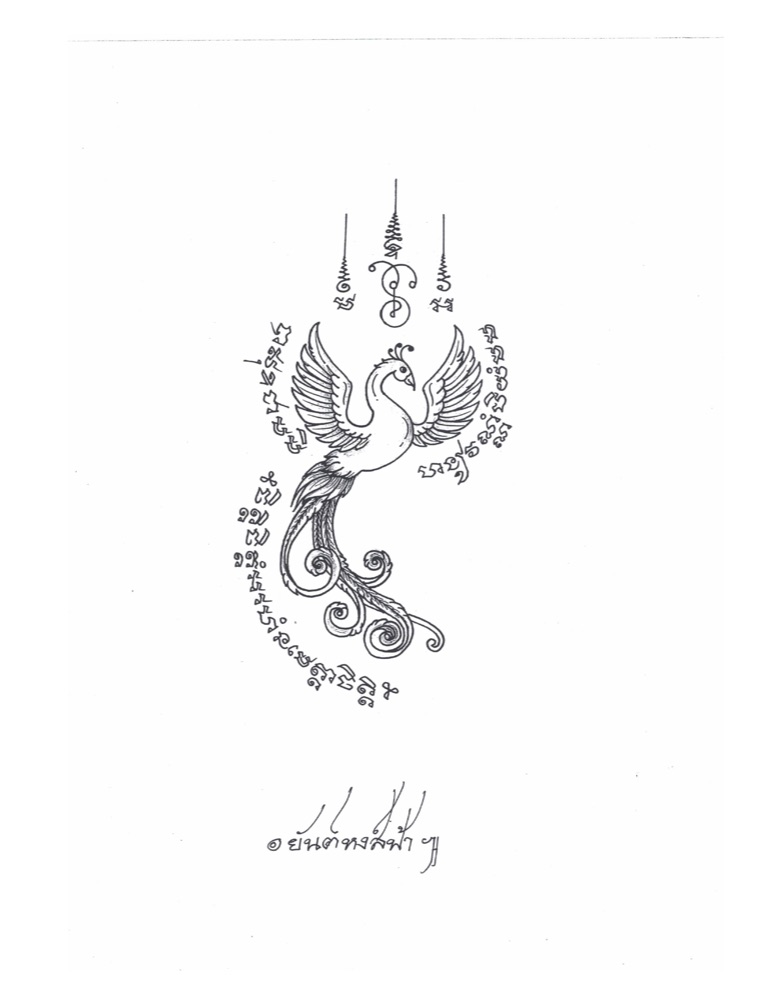
The script changes with the sound. Northern sacred writing runs in Tham script (ตัวธรรม, "Dhamma letters," locally ตัวเมือง) — rounder, older in these hills, the script of the manuscript chests. And it seeps south: even the Bangkok-printed stencil book carries northern plates — its golden hamsa rises wrapped in an arc of Tham Lanna spell-script, three unalome above. Attested — 6985 PDF p.31
๏The dialect is on the page: หื้อ, จุ่ง, ปู่จา
The Lanna lineage treatise doesn't just describe northern practice — it speaks kam mueang. Its wai khru runs in the northern language, and you can hear the hills in every function word:
ขอหื้อได้รับกับหายเสียยังภัยยะ … จุ่งหื้อป่นเสียยังเคราะห์ปี เคราะห์เดือน เคราะห์วัน เคราะห์ยาม … เคราะห์เมื่อหลับเมื่อตื่น เคราะห์เมื่อขึ้นเมื่อแลว … สิ่งบ่ดีบ่งามดังหลายดังมวล ก็หื้อร่ำงับดับหายไป
May it be granted (หื้อ) that all harm be dispelled; may (จุ่ง) the misfortunes be ground away — misfortune of the year, of the month, of the day, of the hour … misfortune while sleeping and while waking, while rising and while setting … all things not (บ่) good, not fair — may they be stilled and extinguished.
Listen to the shape of that prayer as well as its words: the เคราะห์ litany enumerates misfortune by every axis it could arrive on — year, month, day, hour, sleeping, waking — the same exhaustive-coverage instinct as the eight-direction grids in the geometry chamber, done in pure syntax. Where the yant tiles space, the Lanna prayer tiles time. Inference on the reading; the litany is on the page
So the full linguistic stack of a northern nyan can run five layers deep: Pali payload, Central Thai frame, kam mueang performance, written in Khom or Tham, compressed by heart-syllables that work identically in all of them. The main essay's claim — that a sak yant is a multilingual text — is at its most literal in Chiang Mai. Inference
๏A lineage that names its own crossroads
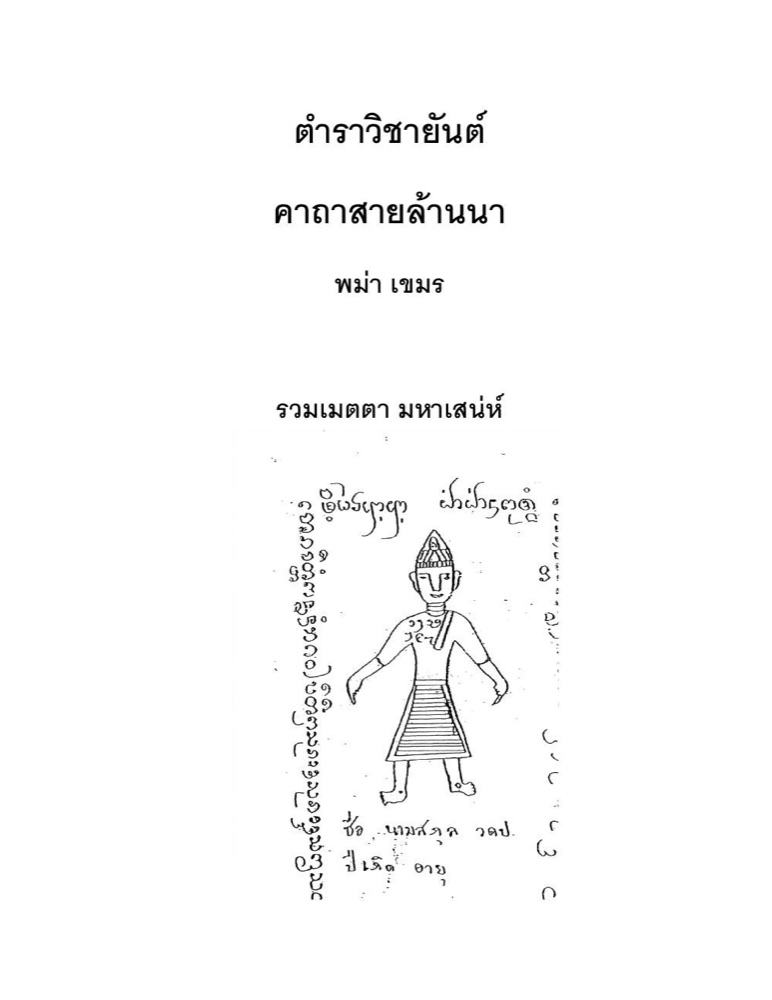
The treatise's title page reads: ตำราวิชายันต์ คาถาสายล้านนา พม่า เขมร — "Yantra craft and kata: Lanna, Burmese, Khmer lineages." Attested — 6980 p.1 The mixture is not an embarrassment to be footnoted; it is the brand on the cover. Inside, the borrowing is concrete: a craft filed as ลงทองเสน่ห์พม่า — Burmese-style charm gilding (the golden-face work whose full glory is in the metta chamber) — and candle rites with names that sit outside Central Thai entirely. Lanna wichaa is what it looks like when a mountain kingdom sits on the caravan roads between Burma, the Shan states, Sipsongpanna and Siam for five centuries: the lineage is the crossroads. Inference on the framing; the titles are in the index
๏Candle-craft: the northern signature, with actuarial tables
If Central Thai yant-craft's signature medium is the takrut scroll, the Lanna book's is the candle. Its contents page is a candelarium: สูตรกำปู่จาเทียน (the candle-veneration formula — pu-ja, northern for บูชา), คาถาจุดเทียนหน้าพระ, เทียนผ่าจ้าน, ยันต์เทียนพญานาคสะเดาะเคราะห์ (the naga candle for shedding misfortune), เทียนปลาดุกเผือก (the white-catfish candle!), เทียนมูตูหลวง. Attested — 6980 index The Bhagavampati candle in the main essay — the one you inscribe with name, birthday and age before it ever melts — is from this same book.
And before any wax is lit, there is arithmetic. The candle-formula section opens with a calculation table — columns the translation renders as Day, Split, Suppress, Chief, Enter, Die — giving a numeric offset for each day of the week, used to determine which condition governs the rite that day, "according to the method of the teachers of old." Attested — 6980 p.6, in kam mueang Candle magic with a lookup table: the same almanac-mindedness that runs the whole northern calendar tradition, here doing quality control on a flame. Nothing in this lineage is vague; even the fire is scheduled.
๏The tower rides a naga; a yantra founds a city
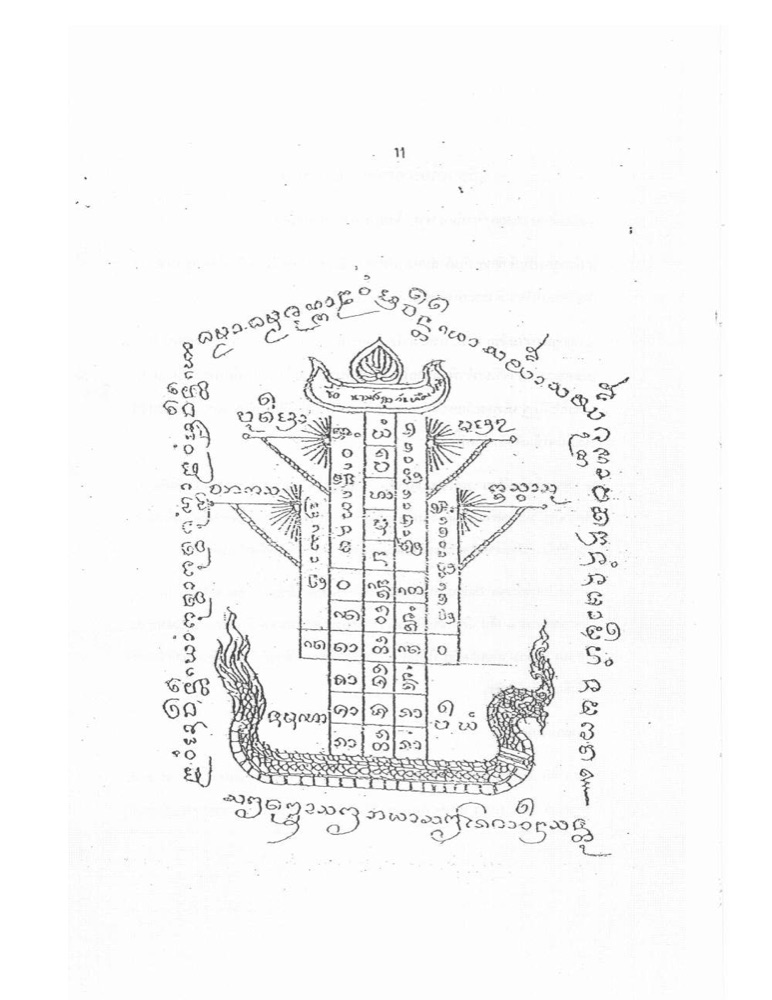
Northern iconography seats its structures on water-power. Early in the Lanna book stands a full-page nyan: a tower of stacked panels, every cell holding a character, a lotus-bud finial at the crown — and the whole edifice rests on the coiled body of a naga, head and tail raised at either side. Attested — 6980 p.5 The serpent of the rivers as foundation course: in a landscape where every wat's stair is a naga's back, the diagram's architecture follows the temples'.
And then the palm-leaf catalogue delivers the fact that reframes the whole genre. Among its 77 nyan manuscripts sits one titled ยันต์แรกก่อสร้างเวียงน่าน — "the first yantra for the founding-construction of Wiang Nan." Attested — corpus catalogue, ms 228 A yantra at civic scale: the device drawn before the city walls rose, the town itself as the inscription surface. Every theme in this essay-suite — geometry tiling space, deixis anchoring a name, activation by lineage — at the scale of urban planning. Your nape tattoo and the city of Nan are, in this catalogue, the same genre of object at different font sizes.
The catalogue's statistics sketch the living geography: the nyan manuscripts cluster in Nan (27) and Lampang (23) — working temples, not archives — and they are overwhelmingly on mulberry paper (67) against palm-leaf (7), because, as the entity page puts it, you draw a yantra to use it, not to shelve it. The dominant title formula is ยันต์และคาถา — nyan lae khatha, diagram-and-spell, two halves of one technology bound in one volume. Attested — entity page statistics
tap the candle — ปู่จาเทียน
Back to the field grammar — or complete the circuit: the gilding craft glows in the metta chamber, the naga's rival flies in the deva chamber, the golden hamsa perches in the menagerie, and the tiling instinct is anatomized in the geometry chamber. สาธุ