๏These animals are predicates
The deva chamber drew a distinction worth restating at the gate: Garuda under Narai is a deictic animal — it points at its rider. The animals in this chamber are predicate animals: wear one and its quality predicates you. Tiger-ness, sweet-voiced-ness, slipperiness — the animal is a trait vector, and the yant catalogues deploy it with the precision of a grammar. The inscription manual's theory page lists the animal forms among the conventional signs established by the old masters "according to meaning and need" — the menagerie is a lexicon, and it was always meant to be read. Attested — 6977 p.34
๏The tiger, fully conjugated
The stencil book's cat section is a paradigm table: ยันต์เสือเหลียวหลัง (tiger looking back), ยันต์หัวเสือ (tiger's head), ยันต์เสือตะปบเหยื่อ (tiger seizing prey), ยันต์เสือคู่ (paired tigers). Attested — 6985 index One lexeme, TIGER, inflected through aspects — vigilance, authority, the strike, the pair.
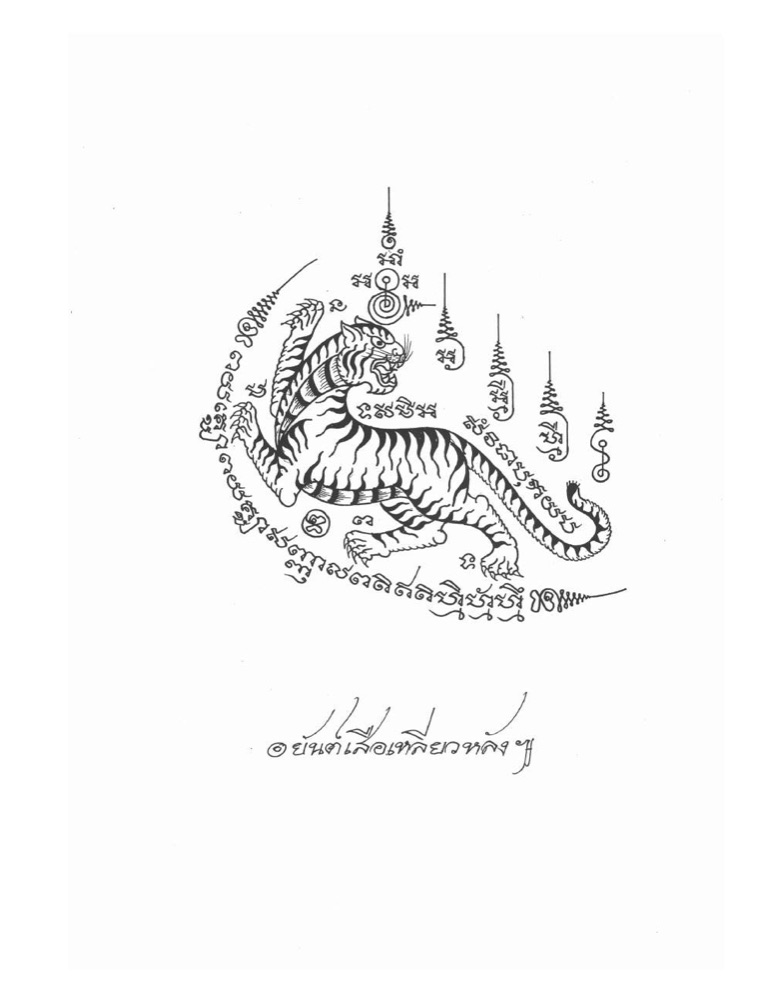
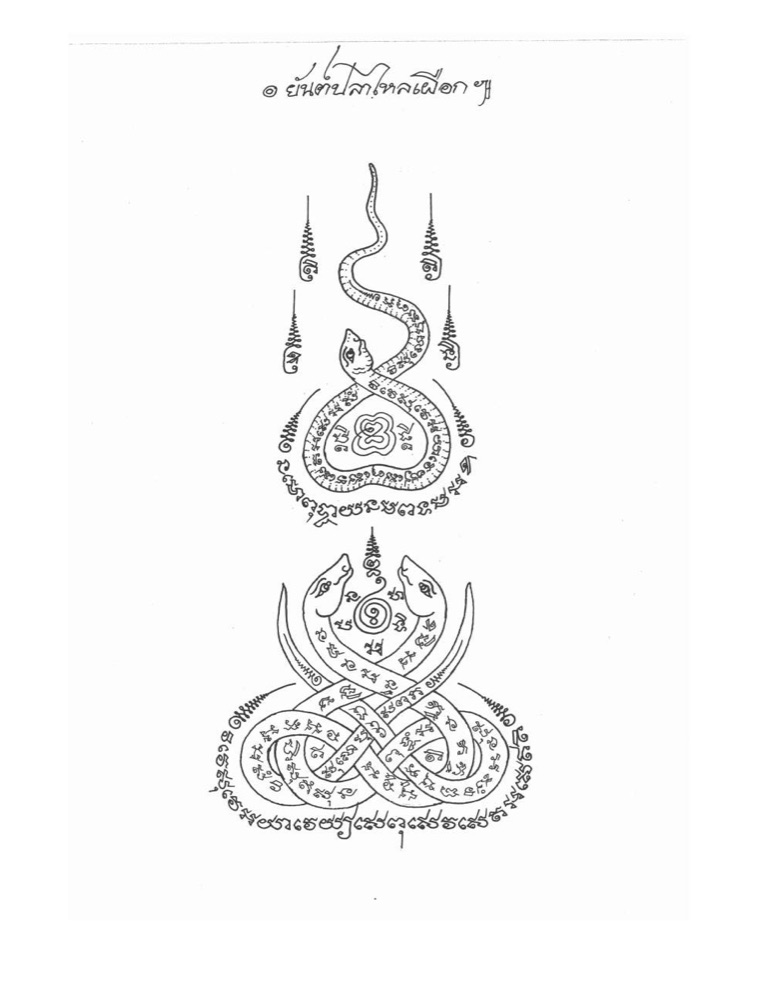
And here is the morphological delight: เหลียวหลัง, "looking back," is a productive modifier. Two pages after the tiger, the same book gives ยันต์ราชสีห์เหลียวหลัง — the mythical lion, head turned over its shoulder, flame-scroll mane, five pendant charms above. Attested — 6985 PDF p.54 The pose transfers across species like an adjective. What does looking-back mean? Inference — the animal that watches its own back wards yours: rear-guard as body English. The pose is doing the grammar; the species sets the register (tiger = raw authority; ratchasi = royal authority).
A neighbouring cousin: ยันต์ลิงกลมกินอาวุธ, the monkey coiled inside a loop, swallowing the weapon — invulnerability phrased as ingestion. Attested — 6985 PDF p.47 The menagerie's verbs are as expressive as its nouns.
๏The bird office: a directory of job titles
The birds are where the system's occupational precision shines. Read the inscription manual's contents page like a staffing chart: Attested — 6977 index, pp.54–61
| Bird | Name | Portfolio |
|---|---|---|
| สาริกาลิ้นทอง | Golden-tongued sarika (myna) | sweet, persuasive speech — ten-plus variants, including male and female forms |
| การะเวก | Karavika | the voice so beautiful all beings pause — eloquence and favour; its takrut kata literally asks for a "honey-sweet tongue" (ชิวหายังมะธุรังวาจัง, 6977 p.59) |
| แร้งถามข่าว | The vulture asking for news | information from afar |
| กาถามข่าว | The crow asking for news | same office, corvid branch |
| นกถึดทือ | The fish-owl | litigation — see below |
| พญาไก่เถื่อน | The wild junglefowl king | waking, summoning, gathering — with a palindrome kata |
| พญากาน้ำ | The cormorant king | another mirrored-syllable charm |
| หงส์ทอง | The golden hamsa | grace, status, auspicious ascent — male and female kata (6989 p.28) |
A vulture whose job is asking for news. This is a fauna sorted not by biology but by communicative function: the sweet-speaker, the far-hearer, the summoner, the status-bearer. A linguist would call it a taxonomy of speech acts wearing feathers. Inference
And the owl. The manual is specific: ยันต์นกถึดทือ — a square frame, a diamond at center, one Khom syllable — ถ้าเป็นความ, "if you are in a lawsuit," write it on the four corners of a cloth, consecrate three times, กระทำเราไม่ได้เลย — "they cannot touch us." Attested — 6977 p.59, printed p.57 The fish-owl, night-sighted and unblinking, retained as counsel. Somewhere in the ancestry of every courtroom drama there is a bird on a piece of cloth.
The rooster deserves his own paragraph, because his kata is a phonological object of real beauty — mirrored pair by mirrored pair: เวทาสากุ กสาทาเว · ทายะสาตะ ตะสายะทา · สาสาทิกุ กุทิสาสา · กุตะกุภู ภูกุตะกุ. Attested — 6977 p.14, quoted as printed Each half-line is the reverse of its partner — and the first pair proves it the hard way. As printed, กสาทาเว runs one syllable short of a true mirror of เวทาสากุ: somewhere in this book's transmission a copyist dropped an อุ. But read the opening half backwards and the reflection hands the vowel straight back — กุสาทาเว, whole again. A mirror-charm carries its own proof of correctness; the palindrome caught the slip the moment it was checked against itself, and circulating versions of the katha transmit the full form. The slip is on the page; the repair is the structure's own doing This is the same mirror-speech the Rahu section found in the eclipse kata, here in a barnyard register. The cormorant's charm on the same page does it too. Reversal is not a Rahu exclusive; it is a whole register of ritual phonology, and the birds fluent in it are the ones whose calls carry — dawn-crier, water-caller. Sound that goes out and comes back. Inference on the reading; the mirrors are on the page
๏Animals have heart-syllables too (tap to collect)
The finding that reorganized this whole chamber for me: the manual's heart-syllable table — the same compression system that shrinks suttas and Buddhas to seeds — includes animals, in the same list, with the same format: Attested — 6977 p.20
Between the heart of the Four Great Lords and the heart of vipassanā sits the heart of the white eel. No fence divides the bestiary from the buddhology; the morphology treats them identically. Whatever has a story dense enough to compress, gets a heart. That is the most theologically generous piece of word-formation I have ever met. Inference on the framing; the table is on the page
The turtle carries it furthest: a heart-syllable in 6977, a whole ยันต์เต่าเลื่อน (moving-turtle lattice, its shell a grid of syllable cells) in the maha-yant manual, and in the Lanna book a craft called วิชาเต่าเรือนแก้อาถรรพ์ — the house-turtle that lifts curses. Attested — 6989 p.13; 6980 index Slow, armored, long-lived, house-shaped: the turtle is the system's image of durable shelter, and it works three genres.
The long tail of the menagerie keeps giving: butterflies (Attested — 6985 PDF p.34), fighting cocks in roundels (PDF p.33), a naga king with five columns of script, tiger-and-singha mirrored around a knot of sigils (PDF p.53). And in the living market the register holds: in the wichaa amulet-market snapshot — 4,380 current listings — เสือ appears in 108 titles, while poor Hanuman manages 9. On skin and stall alike, the tiger still rules the animal economy. Corpus market snapshot, 2026
Back to the field grammar — or onward: the animals' riders are in the deva chamber, their grids in the geometry chamber, the sweet-speech birds' full craft in the metta chamber, and the golden hamsa's northern script in the Lanna chamber. สาธุ