๏The main essay asked what; this wing asks who
The field grammar parsed the yant as a device: script, heart-syllables, layout, activation. But a great many yants on skin are not grids or birds — they are portraits. A four-armed god on a bird-mount. A white monkey in mid-leap. A face with no body, holding the moon in its mouth. When your tattoo depicts a deva, the question "what does it mean" picks up a genitive: whose power, whose story, whose vehicle?
The treatises themselves are wonderfully blunt about how this works. The inscription manual, in its introductory theory pages, says some yants take the form of รูปเทวดารูปมนุษย์ รูปหนุมาน รูปราชสีห์ เสือ — devas, humans, Hanuman, lion-kings, tigers — and that all of it is มติของเกจิอาจารย์แต่เก่าก่อน: "the determinations of the masters of old, established according to meaning and need." Attested — 6977 p.34 The iconography is a conventional sign system — assigned, teachable, revisable — and the tradition says so about itself. No romantic fog required.
And the same page hands us the founding pun of this whole wing. The triangle yant, it says, means the Triple Gem — Buddha, Dhamma, Sangha — or พระผู้เป็นเจ้าทั้งสาม, "the three Lords": พระอิศวร พระพรหม พระนารายณ์ — Shiva, Brahma, Vishnu. Attested — 6977 p.34 One geometry, two cosmologies, zero anxiety. The Hindu devas were never guests in the yant system; they are load paths in the same structure, read in whichever register the work requires.
๏Narai: a god conjugated through his deeds
นารายณ์ Narai is Sanskrit Nārāyaṇa — Vishnu by his grandest name — worn smooth by centuries of Thai mouths. In the yant books he almost never stands still. He appears conjugated through his actions, each deed a named form, exactly the way the tiger appeared inflected through its poses in the main essay.
The clearest display is in the maha-yant manual's teaching on the eight-direction Itipiso, where each compass direction's segment of sacred text bears the name of a Narai deed: นารายณ์กลืนสมุทร, Narai swallowing the ocean, at the south; นารายณ์พลิกแผ่นดิน, Narai flipping the earth, at the southwest; นารายณ์กลืนจักร, Narai swallowing the discus, at the northwest; นารายณ์ขว้างจักร, Narai hurling the discus, at the north; นารายณ์แปลงรูป, Narai transformed, at the northeast. Attested — 6989 p.22 Vishnu's mythology, deployed as a mnemonic coordinate system for text traversal. The avatar list becomes an addressing scheme.
The Scripture of 108 Special Na keeps two of these deeds as single letters: นะนารายณ์แผลง (Narayana's transformation) and นะนารายณ์แปลงรูป (Vishnu-transformed). Attested — 6964 pp.21, 44 And one entry adds the loveliest colophon a glyph ever had — its own placement instruction, right in the name:
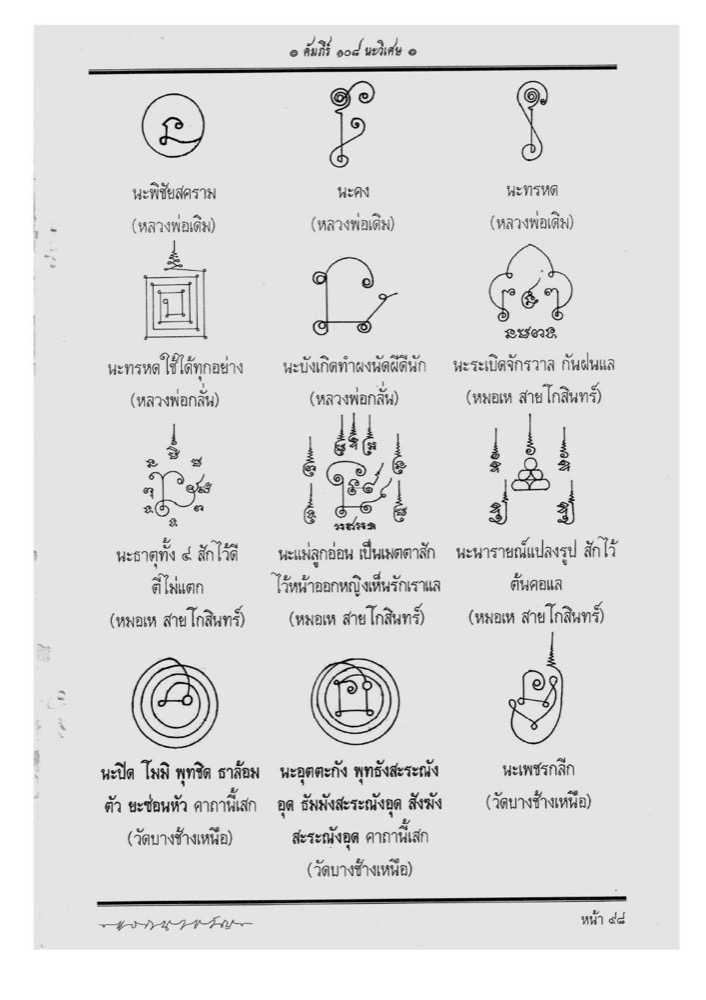
Why the transformation deeds, of all Vishnu's résumé? Inference — because shape-shifting is the working power a wearer can borrow. A tattoo of Narai-transformed is a standing license to become what the situation requires — the yant catalogues elsewhere offer ยันต์นารายณ์แปลงรูป and ยันต์ชุบตัว ("self-renewal") side by side, which reads like a job description. Attested — 6977 index
๏The mounts: from tattoo stencil to national letterhead
Now the vehicles. Sanskrit calls them vāhana, "that which carries" — each great deva has one, and the mount is not transport but signature: you know the rider by what he rides. The stencil book carries the definitive image:
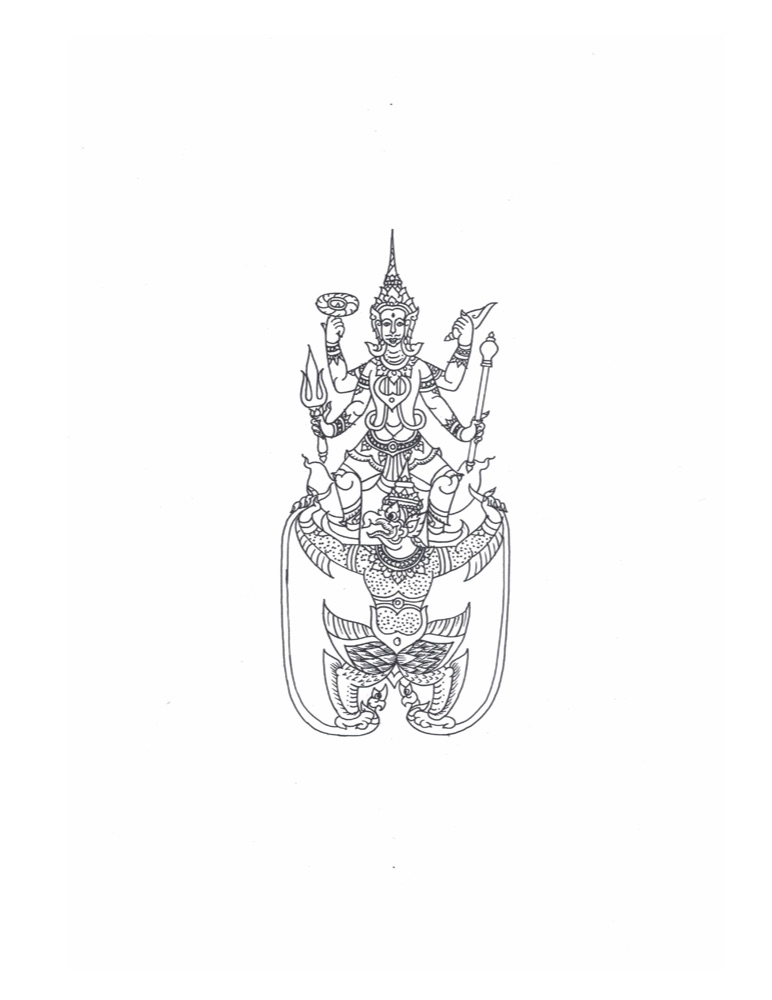
Look at the verb in that stencil's caption: ทรง song. In ordinary Thai it is the royal honorific verb — kings ทรง everything they do — and it also means "to ride, to bear, to wear." A single verb that fuses mounting a vehicle with exercising majesty. The grammar itself says: to ride Garuda is to reign. Inference — but the polysemy is in any dictionary
And this is no antiquarian point, because the mount in that tattoo stencil is also the emblem of the Thai state. The national emblem is the พระครุฑพ่าห์ — "Garuda as vehicle" — formalized under Rama VI in 1911, resting on the old doctrine that the king is an incarnation of Narai; the god's mount therefore signs the king's (and now the government's) documents. Every official letterhead in the country carries Vishnu's bird. Emblem of Thailand — Wikipedia
Better still, the old royal seal system was a complete vahana paradigm: among the four great seals were the Khrut Pha (Garuda — Narai), the หงสพิมาน Hongsaphiman (the hamsa — Brahma's mount), and the ไอราพต Airaphot (the elephant Airavata — Indra's mount), beside the Maha Ongkan of Shiva. same source Four gods, three of them present by their vehicles. The mount system runs, unbroken, from a tracing-book stencil sold to tattoo masters to the stationery of the state. If you wear a Garuda, you are wearing a sentence whose subject is implied by its vehicle — the same metonymy, up and down the whole culture. Inference
One register note, because the corpus makes it visible: in the yant books the animals of function (tiger, sarika, monkey) and the animals of carriage (Garuda, hamsa, elephant) behave differently. A tiger yant grants tiger-qualities to you. A Garuda under Narai grants nothing by itself — it identifies him. Predicate animals versus deictic animals. The Lanna lineage book's wai khru even calls the roll of powers with ครุฑ นาคน้ำ — Garuda and the water-Naga — side by side, the sky-rider and the river-serpent, ancient rivals seated at the same table of guardians. Attested — 6980 p.3
๏Hanuman's battalion: the Ramakien conjugation table
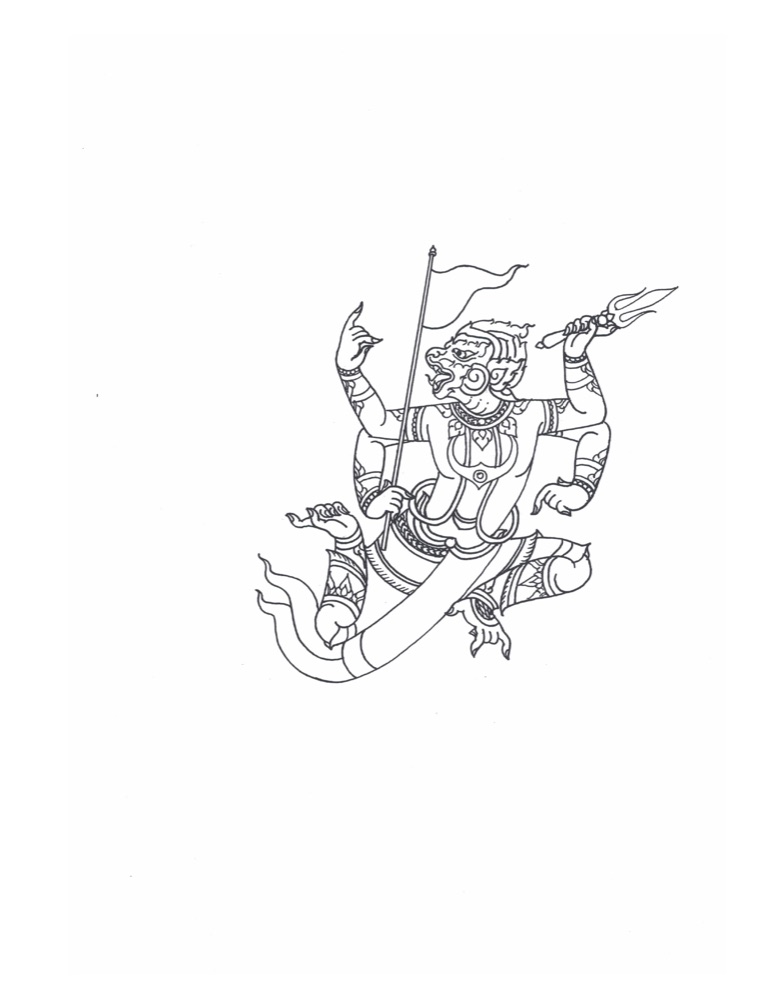
The stencil book's monkey section is a Ramakien muster roll, and — as with the tigers and the Narai deeds — it is one lexeme inflected through aspects: ยันต์หนุมานรับอาวุธ, Hanuman receiving weapons; ยันต์หนุมานเชิญธงนำทัพ, Hanuman bearing the battle-standard; ยันต์พญาพาลี, Lord Phali; ยันต์องคต, Ongkhot; ยันต์ลิงลมออกรบ, the wind-monkey going to war. Attested — 6985 index
The names are a philology lesson in themselves: หนุมาน is Hanumān barely changed; พาลี is Vālin, the monkey-king whose boon stole half of any opponent's strength (which is exactly why he is tattooed — you wear the debuff aura); องคต is Aṅgada, Vali's son, the incorruptible envoy. Thailand received the Rāmāyaṇa and retold it as the Ramakien, and the tattoo catalogue quietly assumes you know the whole epic — each stencil is a hyperlink into it. The design family works like the Na names in the main essay: proper names as compressed hagiographies. Wear the name, carry the story, borrow the trait. Inference on the framing; the muster roll is on the page
๏The body as seating chart
Before Rahu, one hinge passage — because it explains what deva tattoos are for in the tradition's own voice. Several treatises carry versions of an invocation that seats the pantheon on the reciter's body:
ขออัญเชิญพระพรหมเสด็จมาอยู่เบื้องบ่าซ้าย ขออัญเชิญพระนารายณ์เสด็จมาอยู่เบื้องบ่าขวา ขออัญเชิญพระแม่คงคาเสด็จมาเป็นน้ำลาย ขออัญเชิญพระพายเสด็จมาเป็นลมปาก ขออัญเชิญพญานาคเสด็จมาเป็นสร้อยสังวาล
I invite Phra Phrom to my left shoulder; I invite Phra Narai to my right shoulder; I invite Mother Ganga to be my saliva; I invite the Wind God to be the breath of my mouth; I invite the Naga King to be my necklace…
The body is a seating chart for the cosmos — shoulders as thrones, saliva as a river goddess, breath as the wind god. A deva sak yant makes one seat permanent: ink holds the chair. And the guest list has depth behind it — the same manual's great invocation calls Shiva the first teacher outright: ครูกูชื่อพระอิศวร ผู้เป็นเจ้าเธอจึงใช้ให้กูตั้งฟ้าแลแผ่นดิน — "My teacher is named Phra Isuan (Shiva), the Lord who had me set up sky and earth." Attested — 6989 p.13 The wai khru chain runs through the 108 rishis all the way up to Shiva as ur-guru of the whole วิชา. Your tattoo's lineage, followed far enough, ends on Mount Kailash. Attested — 6977 p.32 names the 108 rishis; the flourish is mine
๏Rahu, who always gives it back
tap the moon — he always gives it back
Everything in this essay converges on Rahu, because Rahu is where iconography, astronomy, ritual arithmetic and — I promise this connects — reverse-order phonology meet on one patch of skin.
The story first, told across the Hindu world: when the ocean of milk was churned, the asura Svarbhanu slipped into the row of gods and drank the amrita. The Sun and Moon informed on him; Vishnu — in his enchantress form, Mohini — took his head off with the discus. Too late: the nectar had passed the throat. The head lived on as Rahu, the trunk as Ketu, and the head has chased the two informers ever since, swallowing them at intervals — but having no body, he cannot keep what he swallows. Every eclipse ends. The name itself says the mode of action: Rāhu, "the seizer," from Sanskrit √rabh, to grasp. Rahu — Wikipedia; wisdomlib A seizer, not a keeper. This is why, in Thai practice, Rahu is not a figure of dread but of turnover — the power that takes the dark hour and then releases it. You petition Rahu precisely when you want the swallowing to end. Inference on the framing; the practice below supports it
Notice, too, who beheaded him. In the maha-yant manual's eight-direction scheme, นารายณ์ขว้างจักร — Narai hurling the discus — holds the north, and the very next station, the northwest, belongs to Rahu. Attested — 6989 p.22 The thrower and the thrown-at, seated adjacent on the same compass, both employed as guardians. The yant tradition does not pick sides in devas' quarrels; it hires everyone.
นะราหู and the arithmetic of twelve
Rahu has his own letter: the Phetcharat manual's spiral-glyph chart lists นะราหู — Na Rahu — right between นะปิดปาก (Sealed-Mouth Na) and นะเสือ (Tiger Na). Attested — 6960 p.23 He counts among the Nine — the manual's number-decoder glosses the numeral ๙ in a yant as the เทวดานพเคราะห์, the nine planet-deities: Sun, Moon, Mars, Mercury, Jupiter, Venus, Saturn, Rahu, Ketu. Attested — 6989 p.42 So every nine-spired yant quietly contains him.
And here the corpus does something quietly spectacular: it agrees with the living almanac to the digit. The manual's wai khru recites the "virtues" of the planets as numbers — Sun 6, Moon 15, Mars 8, Mercury 17, Saturn 10, Jupiter 19, Rahu 12, Venus 21, Ketu 9. Attested — 6989 p.72 These are the classical กำลังพระเคราะห์, the planetary strength-numbers still used across Thai astrology today. myhora — planetary strengths; the royal coronation glossary Rahu's number is 12 — which is why everything offered to him comes in twelves.
Proof in the corpus's own kitchen: the Lanna lineage book closes with a complete พิธีไหว้ราหู, a Rahu veneration rite. Twelve incense sticks. A table set in the open air under white cloth. And a menu with a distinctly midnight palette — black sticky rice, black coffee, dark palm-sugar pudding (no coconut, twice underlined), liquor, beer, cigarettes, a whole fish with head and bones intact. Attested — 6980 p.137 The living mainstream agrees on the palette: at Wat Srisathong in Nakhon Pathom, Rahu's great temple, the standard offering is eight black things — black chicken, black liquor, black coffee, grass jelly, black beans, black sticky rice, black pudding, century eggs — presented on Wednesday nights, Rahu's watch. Matichon on Wat Srisathong; MThai Dark foods for the dark planet: the offering table is an icon of its recipient, which is to say the menu is written in the same sign system as the tattoo. Inference
Mirror-speech for the swallower
Now the linguistics payoff. The rite's kata come in a day form and a night form, each recited twelve times — and set them side by side and you can watch the night text reverse the day text, syllable by syllable, in mirrored pairs around มะมะ:
กลางวัน: กุเสโต มะมะ กุเสโต …
กลางคืน: ยะทาดัง มะมะ ดังถายะ ๚ ดังเสกา มะมะ กาเสดัง ๚ กาติยะ มะมะ ยะติกาNight line, literally: ya-tha-dang · mama · dang-tha-ya — the same three syllables, walked forward and then walked back.
These are the famous paired Rahu kata the living tradition calls สุริยบัพพา and จันทบัพพา — the sun-eclipse and moon-eclipse verses. MThai — the day/night Rahu kata And the manual's eight-direction table assigns Rahu his own heart-string, คะพุทบั่นทูธัมวะกะ — a formula the wider tradition circulates as Rahu's heart-kata. Attested — 6989 p.22; Sanook on the Rahu kata Reversal is Rahu's phonological register the way black is his culinary one: for the being who runs the world backwards — who makes light go dark at noon — you speak the words backwards too. Sound-symbolism at the scale of ritual grammar. The eclipse is a palindrome: it undoes itself. Inference — the mirror structure is on the page; the reading is mine
So what does a Rahu tattoo mean — the fanged face, cheeks swelling, the gold disc half-vanished into his mouth (ราหูอมจันทร์, "Rahu holding the moon in his mouth")? Run this wing's questions: who — the seizer, ninth of the planet-deities, strength twelve. What story — the amrita, the discus, the deathless head. What register — mirror-kata, black offerings, Wednesday night. And what work — the turning of a dark stretch, worn by people born under his watch or walking through one. It is the most precisely auspicious tattoo in the whole catalogue, because its promise is built into its anatomy: whatever he takes, he has nowhere to keep. He always gives it back.
Back to the field grammar for the parsing tools — or into the sibling chambers: geometry, animals, metta, Lanna. Or keep wandering the shelves: the 108 Na · 271 described diagrams · the moon complication (Rahu's favorite instrument on the site, surely). สาธุ