๏The shapes come with a glossary
The main essay read yant layout as syntax. This chamber reads the vocabulary of that syntax — because the inscription manual, bless its pedagogical heart, includes an actual shape glossary. The triangle, it says, means the Triple Gem — or the three Lords, Shiva-Brahma-Vishnu (that double reading has a chamber of its own). And then: ยันต์สี่เหลี่ยม หมายถึง ธาตุทั้ง ๔ หรือจตุราริยสัจจ์ ๔ ที่พระพุทธเจ้าได้ตรัสรู้ — "the square yant means the Four Elements, or the Four Noble Truths the Buddha awakened to." Attested — 6977 p.34
Sit with that for a second: the square is polysemous between physics and soteriology. Element-square when the work is worldly; truth-square when the work is liberation; same four cells. Every geometric primitive in the system carries this kind of double load, and the treatises are perfectly comfortable saying so in plain prose. The mystery is not in hidden meanings — the meanings are printed — it is in how much weight the simple shapes are asked to bear. Inference on the framing
๏Grids by the job: a size-and-purpose catalogue
The Phetcharat manual has a page that reads like a hardware-store shelf of squares. Eight 3×3 grids, one per compass direction, each direction called by its classical name — ทักษิณ หรดี ปาจิม พายัพ อุดร อีสาน — to be fixed around a house against spirits. A small numeral square for the house-post, "wards off everything." A 4×4 grid with little hearts drawn in some cells, "to keep ghosts from seizing a child's hand." A 2×2 with repeated letters for the lid of a container, "loving-kindness — everyone loves you." Attested — 6960 pp.14–15
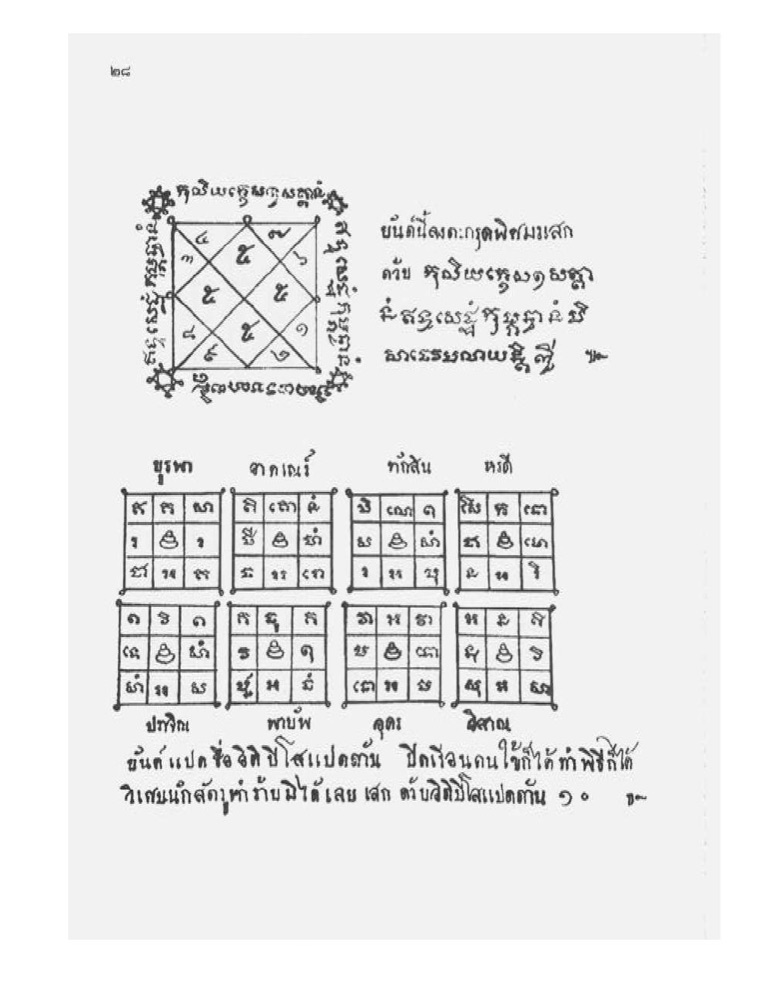
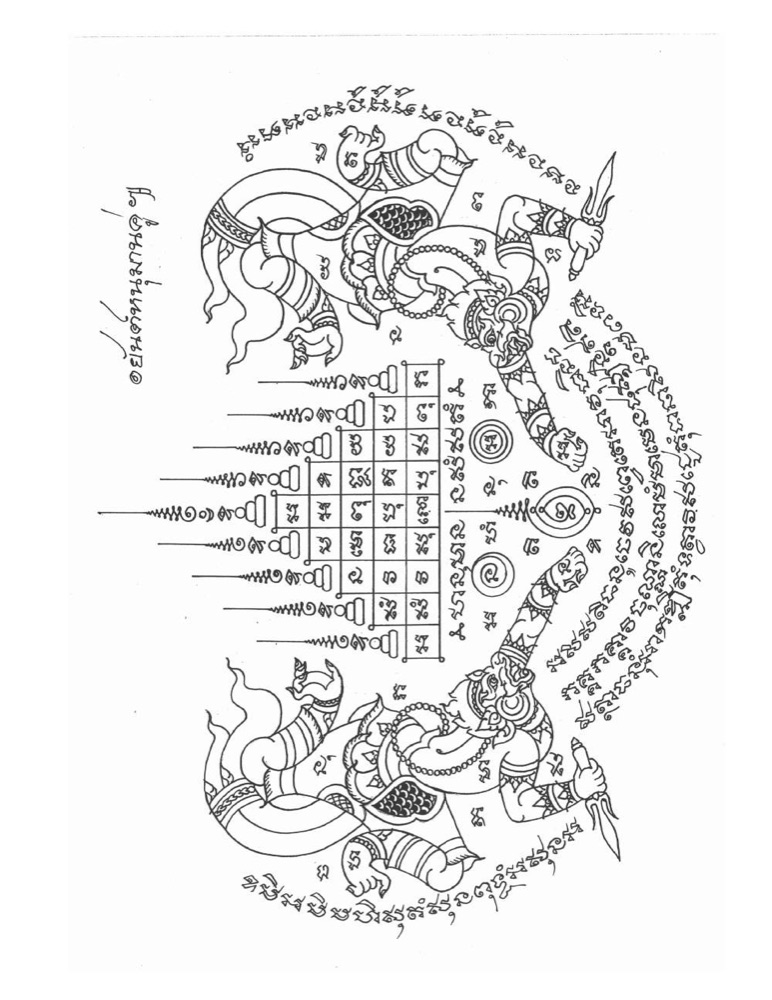
Note what varies: size tracks scope. Two cells for a cosmetics lid; four for a child's wrist; nine for a compass direction; and at the far end, the ครอบจักรวาล — "Encompassing the Universe" — designs that open the stencil book. Attested — 6985 p.2 The manual's grids are sized like antennas: cut to the wavelength of the thing addressed. Inference, and I will not be talked out of it
Geometry even leaves the paper entirely. The maha-yant manual, for sleeping safely in the forest: knead eight balls of earth, consecrate them three times, set them out at the eight directions around your bed, and sleep. Attested — 6989 p.69 That is a yant with no ink at all — pure layout, drawn on the world with clay. The diagram was never really about the drawing.
๏Numbers are words (tap to decode)
Why is a grid of numerals sacred? Because in the lek-yant system the numerals are not quantities — they are citations. The maha-yant manual prints the decoder: each digit indexes a roster of beings. Attested — 6989 p.42
And the inscription manual completes the thought with a startling equivalence: to inscribe the numeral ๔, it says, you may write จะภะกะสะ — or ทุสะมะนิ — instead. Attested — 6977 p.38 A digit and a four-syllable kata are interchangeable spellings of the same value. The numeral is a macro; the syllables are its expansion. Anyone who has ever aliased a long command will feel the deep rightness of this. Your tattoo may contain compressed text at two levels — heart-syllables compressing suttas, and numerals compressing the heart-syllables.
๏The letter is alive, so the letter gets a lock
The same theory page gives the general inscription formulas — อักขระยันตัง อุปปัชชะติ for a letter, เลขยันตัง อุปปัชชะติ for a numeral: "the letter-yant arises." Then it adds an instruction that tells you everything about the ontology underneath: once written, the character must be locked in place — เพราะถือว่าอักขระ... — because a letter, unfastened, is held not to stay put. Attested — 6977 p.38
This is the same world the main essay found in the Na scripture, where glyphs are born, named, and woken. Writing here is not the recording of speech; it is animation. A yant is a corral of living characters, and the lock formula is the gate. When people say a tattoo has power "in the letters," the treatises mean it with a literalism that would delight any philosopher of writing systems. Inference on the gloss; the lock instruction is on the page
๏The AUM-body: MA is the head, A is the body, U is the feet
The tallest structure in yant geometry is the องค์พระ ong phra — the stacked, chedi-like Buddha-figure that crowns so many designs. The manual gives its blueprint in three registers, each drawn with its own birth-formula:
๏ มะกาโร สีสะพุทธา ปะนะชายะเต — ลงตอนบน สมมุติให้เป็นพระเศียร
๏ อะกาโร องคะพุทธา ปะนะชายะเต — ตอนกลาง สมมุติให้เป็นองค์
๏ อุกาโร ปาทะพุทธา ปะนะชายะเต — ตอนล่าง สมมุติให้เป็นพระบาทThe letter MA is born as the Buddha's head; the letter A is born as the Buddha's body; the letter U is born as the Buddha's feet.
Three phonemes — MA, A, U — assembled into an anthropomorphic stack. Readers of Indic tradition will recognize the inventory instantly: these are the constituents of the syllable AUM, redistributed onto a body plan, head to feet. The figure you see rising spire-like from a tiger's back or a grid's crown is not a picture of a chedi that happens to be holy: it is a word wearing a body — built letter by letter, register by register, exactly like the Na anatomy but at architectural scale. And it rhymes with the invocation in the deva chamber that seats gods on shoulders and rivers in saliva: body-as-text, text-as-body, all the way up. Attested — 6977 p.39; the AUM observation is mine
๏The permutation engine, or: word order is the program
The main essay's rotation square — นะ มะ พะ ทะ cycling through a Latin square — turns out to be the visible face of a full combinatorial system. The manual's element-theory page lays it out: the four buddies map to the Four Elements, and each element has a department — water for loving-kindness, earth for toughness and invulnerability, fire for exorcism and driving out spirits, wind for concealment and vanishing. Attested — 6977 p.46
Then comes the sentence that made me put the page down for a moment. Different orderings of the same four syllables are listed as different instruments: นะมะพะทะ in that order works toward arising and fruitfulness — and the reorderings that follow are filed with escalating plain-language warnings, up to the gravest. Attested — 6977 p.46 Same alphabet, same multiset, different permutation, categorically different device — the manual treats anagrams the way a pharmacist treats isomers. Word order is not style here; it is the program. I know of no clearer demonstration, in any tradition, that syntax carries force — and it sits in a tattoo manual, printed decades ago, next to the spelling drills. Inference on the comparison; the permutation table is on the page
This is also the quiet answer to why the treatises drill script so patiently before teaching a single design: in a system where sequence is power, spelling is safety. The primer isn't preliminary to the magic. It is the magic's containment vessel.
Back to the field grammar, or keep wandering: the shapes' inhabitants live in the menagerie and the deva chamber; the warm-current work is in the metta chamber; the northern script and dialect in the Lanna chamber. สาธุ